The
complicated relation between image and word
I
wanted to talk about the exploration of
images and words, or, more directly, the complicated relation among the two.
Complicated relation is a
matter of emotion. I was, basically, a writer, but then I started to use words less to
create since I began
to do photography. My photography usually
employs different overlapping concepts, thus I answered those who asked, my
photography is influenced by the way I lived with words in the past. Such influence is mostly
brought by poem-writing, overlapping imagery and multipoint perspective etc.
In recent years, the way of reading has changed. This probably affected my emotion
about images and words indirectly. The two major photography series that I have done in these few years both have a more direct relation
with words. "Z FICTION" is one of the two; it is a
series of photographs which is fictionally narrative.
The story was constructed during the process of creating the images, and a
short paragraph was then appended. The text is an extension
and also a part of the image. Each photograph is an independent entity. "MOBILE
POETRY LAB" is the other one of the two, it is now on exhibition.
The "MOBILE POETRY LAB" series was put into
progress since 2011. Haven't been writing poems for many years and one day this
idea suddenly came into my mind – why not replace words with
images but retain the way of arrangement of words? Such “photo-poem” is also
arranged line by line, verse by verse, like the traditional poem. The first work is "In January, 2011 passed by
Tokyo to visit an old friend. He was away". If substituting words with images
is hardly intelligible, then try to imagine a composer writing a poem with
music. Every piece of music can indeed be understood as a creation of poem. Because
of the difference of the media used, the messages conveyed are thus different in dimension. Words are concrete and precise, musical
notes are abstract, and images are probably between these two.
In 2012, another idea came into my mind – why not translate these photo-poems into words? This means to write poems with words within a planned
area, for example planned number of lines, and unchangeable topic etc. After
all, I am a writer again.
What if the image version of the text did not come first? The direction must be different;
the mental state during the process of creating would also be altered.
In this series, not every photo-poem has its textual
counterpart. Besides,
try to imagine that the two media have
their own characteristics – words are precise while images are representational and they provide
different rooms for imagination. With the two media in hands, how much is emancipated depends on the environment. "MOBILE POETRY LAB"
has opened a new branch later on. I made some three-jointed style
"imagery Haiku". They were
mainly my notes from reading, and records of gathering with friends etc.
“Z
FICTION” is a narrative of a fictional story, while “MOBILE POETRY LAB” is more
of a record of events. This is perhaps the more obvious distinction between the
two. When you hear a piece of music and a friend coming from afar to visit you,
you may find a straight photograph insufficient to capture that complicated and
overlapping moment. This is also the birth of this series.
I
would rather call this tiny exhibition a conversation with my Hong Kong
friends. I have brought a few works with me and you can see what I had
mentioned about the so-called “record of events” from the titles. Such as “Listening
to one of the two CDs by Forbidden City Chamber Orchestra, purchased in a short
trip to Guangzhou early this year”, “Tse Chi Tak visited on June 2nd. He gave us his book
"KING HEAVEN AND EARTH QUEEN". Here is somehow, a poem on Hong Kong
photography”, “A love poem for Holly, after her new work - CLAW SCRIPT”, “The
Psychological Journey while Taking a Colour Photograph of a Dinosaur”.
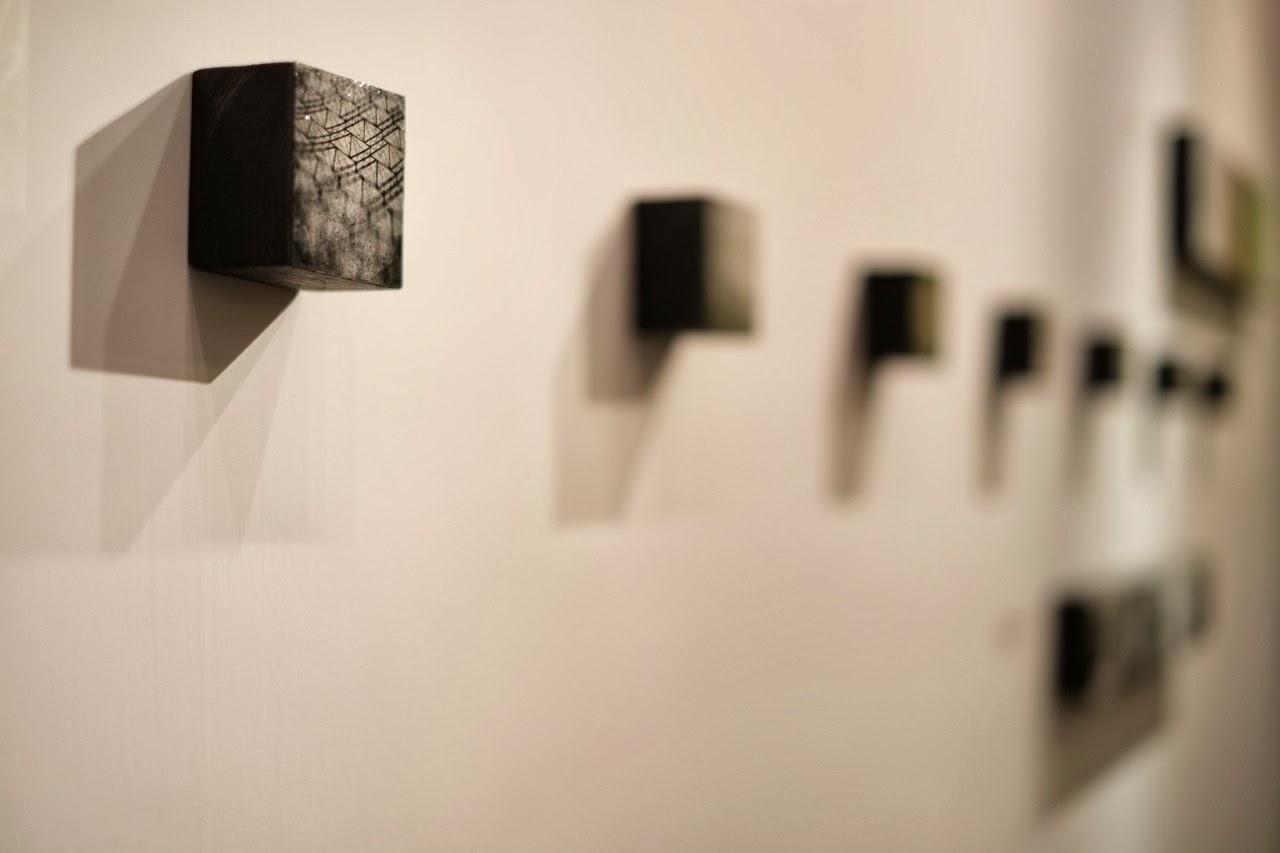
“MOBILE
POETRY LAB” was originally composed of scattered small wooden blocks with
pictures on them. I tried to connect the pictures and made a larger version for
some. There are some changes on the way of presenting.
Patrick
Lee knew that I was exhibiting at the gallery planned by Lau Ching-ping, and he
wanted to respond. Located in the same building, Lumenvisum, where Tse Ming-chong
is the curator. A conversation with one more voice from a friend became more
3-dimensional with one more perspective. I have also put a work in his
exhibition even though that could not be counted as a conversation. “Listening
to Wu Zhaoji's Qin music at Patrick Lee's exhibition in Toronto” – this was
written in May 2013 when Patrick Lee was having an exhibition in my gallery in
Toronto. It also revealed another dimension.
It
was exactly one year after the death of Leung Ping-kwan when “MOBILE POETRY LAB”
was exhibiting in Hong Kong. In Hong Kong Central Library, there was a rather
large-scale art exhibition which exhibited more than a hundred artworks created
by different artists in accordance with Leung's poems. I, on invitation, created
two photo-poems for that exhibition. They were “On
the way home. Staring far through the window of an air cabin. One and Two
(rereading the two poems – ‘Home-break’
and ‘Home-furniture’ – written by Leung 25 years ago)”. Meanwhile, the
Hong Kong Fringe Club was also holding a commemoration for Leung in the same
period of time. It exhibited the works by Leung’s friends and arts
practitioners who missed him. I wrote a photo-poem after Leung’s death, it is
called “In Memory of PK” (the text version was published in “Hong Kong
Literary”). It was also exhibited at the Fringe Club. All these bits and pieces
of “MOBILE POETRY LAB” altogether constructed the dialogue which connects
different spaces in Hong Kong. It is also a complicated relation. I have
planned to hold a larger exhibition of the “MOBILE POETRY LAB” series at
Gallery50 in Toronto in February 2014. This time can be considered a warm-up
for it.
Translated by Man Hoi Yin